Yes, with one large caveat. A cup of hot and sour soup from a Chinese restaurant has about 91 calories, which is genuinely low, and 876mg of sodium, which is genuinely high. It also has one gram of fiber, so it fills you up less than its reputation suggests.
The calories are not the problem. The salt is, and so is what usually arrives at the table right after it.
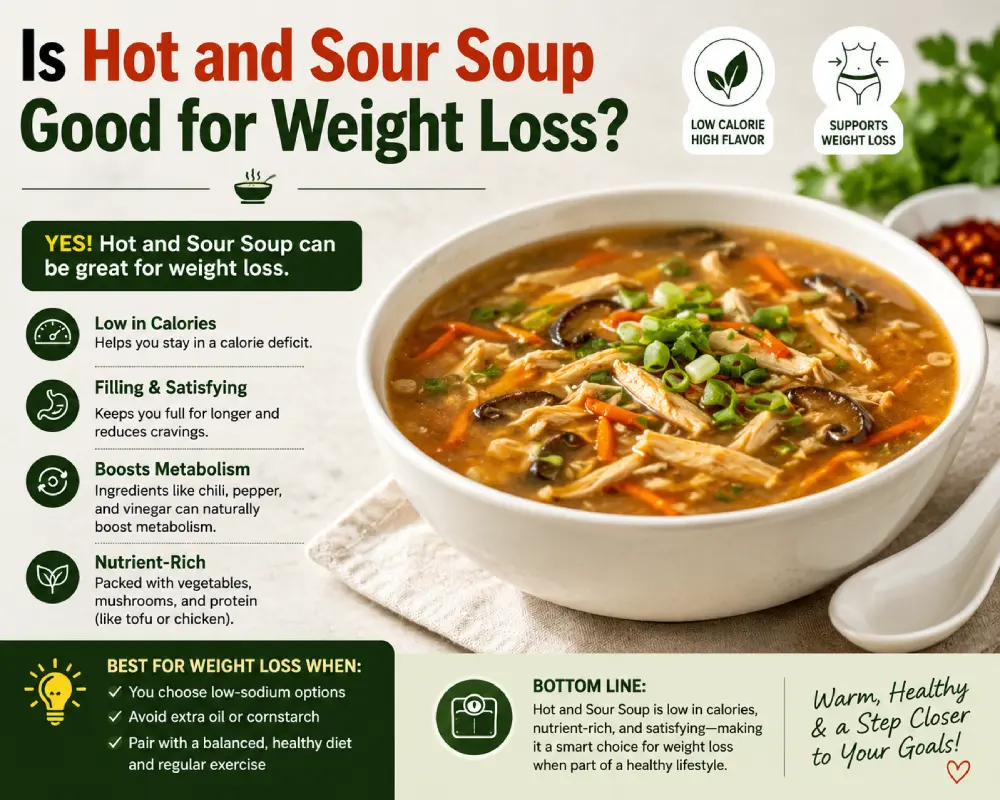
What is actually in a bowl of hot and sour soup
The traditional version is a thin, dark broth built on wood ear mushrooms, bamboo shoots, tofu, and egg, soured with black vinegar and heated with white pepper. Restaurants thicken it with cornstarch and season it with soy sauce, which is where most of the salt comes from.
Here is what USDA FoodData Central lists for one cup (233g) of the restaurant version:
| Per 1 cup (233g) | |
|---|---|
| Calories | 91 |
| Protein | 6g |
| Carbohydrates | 10g |
| Fiber | 1g |
| Fat | 3g |
| Sodium | 876mg |
| Cholesterol | 49mg |
Worth noting how few articles on this topic cite that entry. Most quote each other, which is why you will find pages claiming anywhere from 400mg to 1,200mg of sodium for the same dish. One site publishes three different figures across three of its own pages.
The other thing to notice: a cup is 233 grams. The bowl a restaurant brings you is usually closer to two cups. That doubles everything in the table.
The sodium problem nobody wants to talk about
At 876mg per cup, a single starter uses about 38% of the 2,300mg daily sodium cap in the Dietary Guidelines. Measured against the American Heart Association’s ideal target of 1,500mg, it is closer to 58%.
Order the standard restaurant bowl and you are at roughly 1,752mg. That is more than a full day at the AHA’s ideal limit, consumed before your entree has arrived.
Then the entree arrives. Chinese takeout mains are not low in sodium either.
I want to be fair here, because sodium panic is its own kind of nonsense. If you eat this once a month, none of this matters. Your kidneys handle the excess and you move on. But one of the top-ranking articles on this exact question raises the sodium issue and then waves it away with “I wouldn’t worry that much about this,” and that is not advice, it is a shrug. If you have high blood pressure, or you eat Chinese takeout weekly, the number matters.
Why the scale goes up the next morning
This trips people up constantly. You order the soup, you order sensibly, and the next morning you are up two pounds.
That is water, not fat. Sodium pulls fluid into your bloodstream and tissues, and your body holds onto extra water until the salt clears. Given a couple of thousand milligrams above your usual intake, a swing of one to three pounds on the scale is ordinary and it resolves within a few days.
Nothing you ate turned into two pounds of fat overnight. That would take roughly 7,000 surplus calories. You had soup.
We covered the same mechanism in more detail in our piece on flat tummy water, because it explains most of the short-term scale movement people misread in both directions.
The fiber number is the real weakness
One gram per cup. This is the number no other article on this topic mentions, and it matters more than the calorie count.
Fiber and protein are what make food keep you full. Hot and sour soup gives you a modest 6g of protein and almost no fiber, in a format that is 91% water. You feel full while you are eating it, largely from volume and warmth, and that feeling fades faster than it would after something with real structure to it.
Compare it to a bowl of lentil soup, or a stir fry heavy on vegetables and tofu, and the difference in staying power is obvious within an hour.
This is why hot and sour soup works well as an appetizer and poorly as a meal. Nothing wrong with an appetizer. Just do not expect it to carry you to dinner.
Does soup before a meal help you eat less?
There is decent research behind this. Trials have found that eating a low-calorie, broth-based soup before a meal reduces how much people eat during the meal that follows.
But read the condition carefully. The benefit comes from eating less afterward. If the soup is an addition to your usual order rather than something that displaces part of it, you have added 91 to 182 calories and a large amount of salt to a meal you were going to eat anyway.
That is the honest answer to the question in the title. Hot and sour soup can absolutely support weight loss. It does so when it replaces something, not when it joins the party.
So the useful move is not “should I order the soup.” It is “if I order the soup, do I order fewer spring rolls.”
Hot and sour vs egg drop vs wonton
This is the decision most people are actually making. Here is how the three standard takeout soups compare, per one cup, using USDA-derived figures:
| Soup | Calories | Carbs | Sodium |
|---|---|---|---|
| Hot and sour (233g) | 91 | 10g | ~876mg |
| Wonton (223g) | 71 | 12g | ~900mg |
| Egg drop (241g) | 65 | 10g | ~900mg |
The takeaway is not which one wins. It is that the differences are trivial. Twenty-six calories separate the lightest from the heaviest, which is about the same as a teaspoon of olive oil. All three sit around 900mg of sodium.
If you are choosing between them on calories, you are optimizing the wrong variable. Order whichever you actually like. Hot and sour has a slight edge on protein because of the tofu and egg.
What about the vinegar and the pepper?
Two claims come up constantly, and both are smaller than they sound.
Vinegar. The acetic acid in black vinegar has been studied for its effect on post-meal blood sugar, and there is reasonable evidence it blunts the glucose rise from a carbohydrate-heavy meal. The evidence that it produces meaningful weight loss is much weaker. A tablespoon diluted through a shared pot of soup is not a therapeutic dose of anything.
The heat. Capsaicin does have a small, measurable thermogenic effect, and articles love to cite it. Here is the detail those articles miss: traditional hot and sour soup gets its heat from white pepper, not chili. The active compound is piperine, not capsaicin, and the research on piperine and metabolism is thinner still. Either way, the effect size is a handful of calories, not a mechanism you can build a diet around.
Neither of these makes the soup a bad choice. They just are not reasons to choose it.
How to order it, and how to make it better at home
At the restaurant: ask for a cup rather than a bowl if they offer both. Ask for it without cornstarch if you want it thinner, which many kitchens will do. Do not add extra soy sauce at the table.
At home, you control the only variable that matters:
- Start with a low sodium or homemade broth. Simmering dried shiitakes in unsalted water for 20 minutes gives you a deeply savory base for almost no sodium.
- Cut the soy sauce in half and double the black vinegar. Acidity reads as “seasoned” to your palate and covers a lot of the gap.
- Be generous with white pepper. Heat also compensates for less salt.
- Load it with vegetables. Extra mushrooms, cabbage, carrot, and bamboo shoots move it from 1g of fiber toward something that actually holds you.
- Add more tofu or shredded chicken. This is what turns it from a starter into a meal.
A version built that way lands in a completely different place nutritionally than the takeout one, using the same flavor profile.
Who should be cautious
If you have high blood pressure, heart failure, or chronic kidney disease, or you have been told to limit sodium for any reason, treat restaurant hot and sour soup as an occasional dish rather than a regular one. Two cups is a significant share of a restricted daily allowance.
If you have acid reflux, the vinegar and pepper combination is a common trigger.
On MSG: many takeout kitchens use it, and it does contribute sodium. It is worth knowing that MSG carries roughly a third the sodium of table salt by weight, so it is a smaller contributor than the soy sauce. The decades of alarm around MSG have not held up well to research. The salt is the real issue, not the glutamate.
Frequently asked questions
How many calories are in a bowl of hot and sour soup?
About 91 calories per cup, so roughly 180 for a standard restaurant bowl of two cups. Homemade versions with less cornstarch and oil can come in lower.
Is hot and sour soup healthy?
It is low in calories and fat and contributes a little protein. Its weak points are very high sodium and almost no fiber. Healthy in the context of a takeout menu, unremarkable in the context of a whole diet.
Is hot and sour soup keto-friendly?
At 10g of carbohydrate per cup, mostly from the cornstarch thickener, it is workable on a moderate low-carb approach and tight on strict keto. Ask for it without the starch.
Will hot and sour soup make me bloated?
It can, for a day or so, because of the sodium. That is fluid, not fat.
Is hot and sour soup good for a cold?
There is nothing magic in it, but hot liquid genuinely helps with congestion, and the pepper thins mucus temporarily. As comfort food while you are ill, it does the job.
Can I eat it every day?
Not the restaurant version, mainly because of the sodium. A homemade low sodium version is fine daily if you enjoy it.
The verdict
Hot and sour soup is one of the better things on a Chinese takeout menu, and ordering it instead of fried appetizers is a reasonable choice. That is a real but modest win.
What it is not is a weight loss food. Nothing about vinegar, pepper, or mushrooms burns fat, and 91 calories only helps you if those 91 calories replace something rather than adding to a meal you were already going to eat. Ordering soup does not neutralize the sweet and sour pork.
Make it at home with your own broth and a pile of vegetables and it becomes genuinely useful: filling, high in volume, low in calories, and low in sodium for once. Order it out, enjoy it, and pay attention to what comes next to it on the table. That is where the calories actually are.

Indrani is a passionate health and wellness enthusiast who has dedicated her life to helping others live their best lives. With a background in sports science and nutrition, Indrani has a deep understanding of how diet and exercise impact overall health. She started her health and wellness blog to share her knowledge and inspire others to make positive changes in their lives.
Leave a Reply