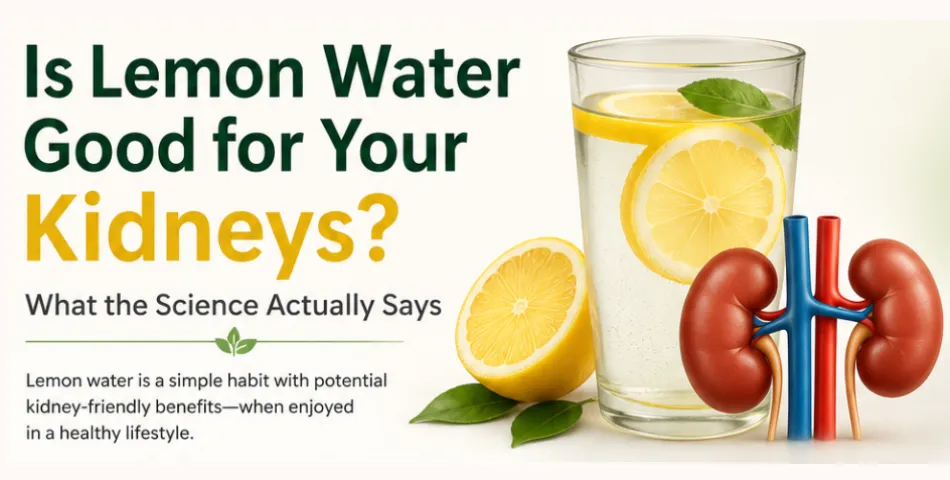
Yes, lemon water is good for your kidneys – but for two specific, well-supported reasons, not the dozen miracle claims you’ll see splashed across wellness blogs. It helps because the citrate in lemon juice makes it harder for the most common kidney stones to form, and because a squeeze of lemon nudges most people to drink more water, which is the single best thing you can do for your kidneys. That’s the honest version. Everything else – the “detox,” the “cleanse,” the idea that it melts existing stones – needs a closer look, and this article gives it to you.
What lemon water actually does for your kidneys
Strip away the hype and lemon water does three measurable things. Two of them genuinely matter for your kidneys. One is a nice bonus.
It loads your urine with citrate, the natural stone-blocker
Lemons are one of the richest food sources of citrate on the planet, and citrate is the part that earns lemon water its kidney reputation. Here’s the mechanism, because it’s actually simple. Most kidney stones are made of calcium oxalate. Citrate works in two ways to stop those stones: it grabs onto calcium in your urine before the calcium can clump with oxalate into a crystal, and it gently raises your urine’s pH, making the whole environment less friendly to stone formation.
Low urinary citrate – doctors call it hypocitraturia – is one of the big risk factors for recurrent stones. Lemon juice helps top those citrate levels back up. The National Kidney Foundation points to this exact effect, recommending about 4 ounces of lemon juice mixed with water as a complementary remedy for people prone to stones.
It makes you drink more water, and that’s the real win
This is the part most “lemon water for kidneys” articles bury, and it shouldn’t be. Plain hydration does more for your kidneys than the lemon ever will. Water dilutes your urine, flushes out the waste products that would otherwise concentrate and crystallize, and lets your kidneys do their filtering job efficiently.
The catch is that a lot of people find plain water boring and simply don’t drink enough of it. Add a squeeze of lemon and the glass becomes something you actually want to finish. So you drink more. That extra fluid – not the lemon itself – is doing most of the heavy lifting. Think of the lemon as the reason you reach for the water in the first place.
A small vitamin C bonus
The juice of half a lemon gives you roughly 10 to 20 mg of vitamin C, somewhere around 15 to 20% of what you need in a day. It’s a real contribution, just a modest one – you’ll get far more from an orange or a bell pepper. One thing worth flagging: very high doses of vitamin C from supplements (above 500 mg a day) can actually raise oxalate production and work against stone prevention. The amount in a glass of lemon water is nowhere near that threshold, so it stays firmly on the helpful side.
Prevent vs. dissolve: what lemon water can and can’t do
Here’s a distinction almost every competing article blurs, and getting it right matters.
Lemon water can help prevent new stones from forming and slow the growth of existing ones. What it cannot do is dissolve a stone you already have. You’ll see plenty of pages claim lemon juice “breaks up” or “melts” kidney stones – that overstates the evidence. Citrate makes the chemical conditions less favorable for stones to grow, and it may keep a small crystal from getting bigger. But it is not a solvent, and it won’t make an established stone disappear.
If you already have a diagnosed stone, lemon water is a reasonable supporting habit, not a treatment. The treatment decision belongs to your doctor.
What the research actually says
Most articles wave at “studies show” without ever telling you what the studies found. So here are the real numbers from the best trial we have.
In 2021, researchers in Bergamo, Italy ran a two-year randomized trial – published in eClinicalMedicine – on 203 people who were prone to recurrent calcium oxalate stones. One group added fresh lemon juice (about 60 mL, or two ounces, twice a day) to a standard kidney-stone diet. The other group followed the diet alone. Over two years, 21 of 100 people in the lemon group had a stone come back, compared with 32 of 103 in the control group.
That’s a meaningful drop, and it’s the strongest evidence we have that lemon juice supplementation helps. But the honest reading comes with two caveats the trial itself noted. First, everyone in the study was already drinking 2 to 2.5 liters of water a day – so the baseline hydration was doing real work underneath the lemon effect. Second, people found it hard to stick with the lemon over two years; adherence slipped, and stomach complaints like heartburn were more common in the lemon group. The signal is real. It’s just not a magic bullet, and the water matters as much as the lemon.
How much lemon water for kidney health, and how to make it
The dose that matches the research
If you’re drinking lemon water specifically to support stone prevention, the rough target from both the research and the National Kidney Foundation is about 4 ounces of lemon juice spread across your day – that’s roughly the juice of two lemons, or half a lemon in each of a few glasses. For general health and hydration, you don’t need to measure anything. Half a lemon in a glass or two of water a day is plenty.
Use fresh lemons, not the bottled stuff. Bottled lemon juice works in a pinch, but it carries less citrate and often contains preservatives. If fresh isn’t an option, look for 100% lemon juice with nothing added.
A simple kidney-friendly recipe
The recipe below is the version renal dietitians tend to favor – low in everything your kidneys don’t want, no added sugar.
Protect your teeth while you drink it
This is the one real downside of a daily lemon habit, and it’s easy to manage. Lemon juice is acidic enough to wear down tooth enamel over time, especially if you sip it slowly over hours. A dental case study once documented a man who drank whole-lemon juice every morning for years and needed crowns to repair the erosion. You don’t have to go that far to do minor damage.
Three habits keep your teeth safe. Drink through a straw so the acid mostly bypasses your teeth. Rinse your mouth with plain water after you finish. And don’t brush right away – give it about an hour, because brushing acid-softened enamel scrubs it away before it can re-harden. Finishing the glass in one sitting rather than nursing it all morning also cuts the contact time.
Who should be careful with lemon water
For most people, lemon water is about as safe as a drink gets. A few groups should pay closer attention.
People with acid reflux or GERD. The citric acid can trigger heartburn or aggravate reflux. If lemon water leaves you with a burning chest, that’s your sign to dilute it more or skip it. This is also why doctors prescribe potassium citrate pills instead of lemon for stone-prone patients who can’t tolerate the acid.
People with chronic kidney disease (CKD) or on dialysis. Lemon water is actually one of the better beverage choices in CKD because it’s very low in potassium and phosphorus – a glass with half a lemon adds only about 13 mg of potassium, a fraction of what orange juice carries. The real consideration isn’t the lemon, it’s the fluid. If you’re on dialysis and have a fluid restriction, every glass counts toward your daily limit, so work within whatever your nephrologist has set.
People taking certain medications. Citrus can interact with some drugs for blood pressure, diabetes, and heart conditions. (Grapefruit is the notorious one, but it’s worth a conversation for citrus generally.) If you take regular medication, run a daily lemon water habit past your doctor or pharmacist first.
People with a history of oxalate stones, in large amounts. Lemons themselves are low in oxalate, so normal lemon water is fine and even helpful. Just don’t overdo citrus across your whole diet on the assumption that more is always better.
What lemon water does NOT do
A quick reality check, because the internet has oversold this drink.
It does not detox your kidneys. Your kidneys, liver, skin, and gut already remove waste from your body around the clock – that’s their entire job. Lemon water supports them by keeping you hydrated; it doesn’t “cleanse” anything that wasn’t already being handled.
It does not alkalize your body. Lemon water can make your urine slightly more alkaline, which is part of how the citrate helps with stones. But it cannot shift your overall blood pH – your body holds that in a tight range no matter what you drink, and that’s a good thing.
It does not reverse kidney disease, and it is not a substitute for medical treatment. If you have a diagnosed kidney condition, lemon water is a small supportive habit alongside your care plan, never a replacement for it.
Lemon water vs. the alternatives
How does it stack up against the other options people consider for kidney health?
| Option | Stone-prevention value | Best for | Watch out for |
| Plain water | High – dilutes urine, the foundation of stone prevention | Everyone, all day | Nothing; this is the baseline |
| Lemon water | High – adds citrate on top of hydration | People who won’t drink enough plain water | Tooth enamel; reflux for some |
| Lemonade (sweetened) | Low – the added sugar offsets the benefit and adds calories | Honestly, an occasional treat | Sugar; defeats much of the purpose |
| Potassium citrate pills | High – prescription-strength citrate | Stone-formers who can’t tolerate acid or need a measured dose | Prescription only; talk to your doctor |
The takeaway is that plain water and lemon water are both winners, lemonade isn’t really in the same conversation, and citrate pills exist for the people lemon doesn’t suit.
Frequently Asked Questions
Is lemon water good for kidneys?
Yes. Lemon water supports kidney health in two main ways: the citrate in lemon juice helps prevent calcium oxalate kidney stones, and adding lemon encourages most people to drink more water, which keeps the kidneys flushing waste efficiently. It’s safe for most people in normal amounts.
Does lemon water dissolve kidney stones?
No. Lemon water can help prevent new stones and slow the growth of existing ones, but it does not dissolve a stone you already have. An established stone needs medical evaluation, not a home remedy.
How much lemon water should I drink for my kidneys?
For stone prevention, the rough target from research and the National Kidney Foundation is about 4 ounces of lemon juice across the day – roughly two lemons’ worth. For general hydration, half a lemon in a glass or two of water daily is enough.
Is lemon water bad for your kidneys in any way?
Not for the kidneys directly. The main downsides are tooth enamel erosion from the acid and possible heartburn for people with acid reflux. People with advanced kidney disease or fluid restrictions should count lemon water toward their daily fluid limit.
Can lemon water detox or cleanse my kidneys?
No. Your kidneys already filter and remove waste on their own. Lemon water helps by keeping you hydrated so they work efficiently, but there’s no such thing as a lemon “cleanse” that detoxifies the kidneys beyond that.
The bottom line
Lemon water is a genuinely good habit for your kidneys, as long as you’re clear on why. The citrate helps block the most common kind of kidney stone, and the lemon makes hydration something you’ll actually keep up – and hydration is the real engine here. It won’t dissolve a stone you already have, it won’t detox or cleanse anything, and it won’t replace medical care. Drink it fresh, protect your teeth, and keep it in proportion.
If you’re getting recurrent kidney stones, have ongoing kidney disease, or notice blood in your urine or persistent flank pain, skip the home remedies and see a doctor. Lemon water is a helpful sidekick to good kidney care. It was never meant to be the hero.
This article is for general information and isn’t a substitute for personalized medical advice. If you have a kidney condition or a history of stones, talk to your doctor or a registered dietitian before making changes to your diet.
Sources: National Kidney Foundation (kidney.org); Ruggenenti P. et al., “Fresh lemon juice supplementation for the prevention of recurrent stones in calcium oxalate nephrolithiasis,” eClinicalMedicine, 2021.

is a registered dietitian with over 15 years of experience in nutrition, personalised diet planning, and wellness coaching. She holds a Master’s degree in Nutritional Science from University of Dhaka and specialises in evidence-based nutrition strategies that support long-term health and sustainable lifestyle changes. Mounota regularly writes research-backed health and nutrition content for online publications and wellness platforms.
Leave a Reply